Punctuation Marks in Sheet Music: Teaching Kids Musical Syntax Before Touching the Keys
· Updated
We have all witnessed this scene in the studio. A seven-year-old student sits at the piano, places their fingers on the keys, and begins to play: C... (two seconds of silence)... E... (hesitation)... G... (wrong finger)... G again.
It sounds robotic, fragmented, and frankly exhausting for the child.
Whenever I hear this, I gently ask: “Imagine if I spoke to you like this: I... want... to... eat... an... ap... ple. What did I just say?”
The student usually laughs and says, “An apple!” But they immediately see the point. Reading note-by-note is the musical equivalent of spelling out every syllable without understanding the sentence. When children read this way, their working memory gets jammed. By the time they hit the fourth note, they have already forgotten where the phrase started. Musical thinking shuts down before the melody even gets off the ground.
To fix this, we need to teach children musical syntax long before their fingers touch the keyboard. In my studio, we treat sheet music exactly like an illustrated storybook.
1. The Power of the Pencil: Commas and Periods
Before my students play a single measure of a new piece, we open the score and take out a soft pencil. We search for the punctuation marks hiding inside the notes.
-
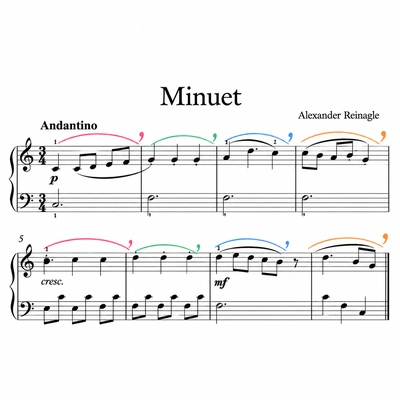
Musical Commas (The Breath): Children often hold their breath when reading music, which creates physical tension in their wrists and shoulders. We look for motifs and micro-phrases, drawing a neat little apostrophe (comma) above the staff where the singer would inhale. I tell them: "Float your wrist here and take a sip of air." Recognizing these natural seams stops the music from feeling like an endless, terrifying wall of black dots.
-
Musical Periods (The Full Stop): Next, we hunt for the end of the thought. Does the phrase land back on the tonic? Does it pause on a half cadence? We draw a tiny dot with a circle around it at the end of every sentence. This teaches the child’s brain to group 8 or 12 individual notes into one cohesive thought. Instead of processing eight isolated events, they only have to process one gesture moving toward a target.
2. The 30-Second Silent Prep Checklist
Once our "punctuation" is mapped out, we initiate our sacred studio ritual: the 30-second scan. The piano lid stays closed, or hands rest quietly in the lap.
Here is the exact three-step routine my students run through out loud:
- The Shape of the Road (Trajectory): I ask: "Is the melody climbing a hill or walking down stairs?" The child traces the contour in the air with their index finger. Even if they misidentify a specific pitch later, their hand naturally prepares the correct physical motion because they already know the overall shape of the line.
- Finding Home Base (The Tonic): We look at the key signature and the final bass note. "Where does this story end?" Finding the tonal center gives them an anchor. Once they know what "home" sounds and feels like, every other note makes sense in relation to it.
- The Weather Report (Mood and Mode): Is the sky sunny (Major) or stormy (Minor)? Is it a march, a lullaby, or a chase? Giving the piece an emotional identity primes their auditory imagination. When children hear the sound in their mind first, their fingers know how much weight and speed to deliver.
The Breakthrough
Last month, an eight-year-old named Leo was struggling through a simple four-measure folk song. He stopped five times in the first measure alone, constantly second-guessing himself.
We stopped. We closed the keyboard cover. We found two commas and one period, traced the gentle arch of the melody, and decided the piece sounded like "a sneaky cat walking on a fence."
When he opened the lid and tried again, he played the entire passage without stopping once. The rhythm was steady, his wrists were flexible, and his eyes stayed focused on the phrases rather than individual stems.
Notes are just letters. Punctuation and structure turn them into stories. When we teach young pianists to read the meaning before the mechanics, sight-reading stops being a test of reflexes and becomes what it was always meant to be: expressive communication.
Please note: The illustrations featured in this article were created with the assistance of AI.