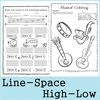
Looking for a simple way to introduce staff reading with music staff worksheets?
I created these pages to help young beginners understand staff anatomy and spatial pitch direction before introducing clefs and letter names. Students connect dots to draw staves, identify lines and spaces, trace and draw noteheads, and compare high and low pitches. They work well for independent practice, music centers, sub plans, and early finishers.
It includes:
Line-Space (17 worksheets):
~ Draw a staff worksheet and number the lines and the spaces.
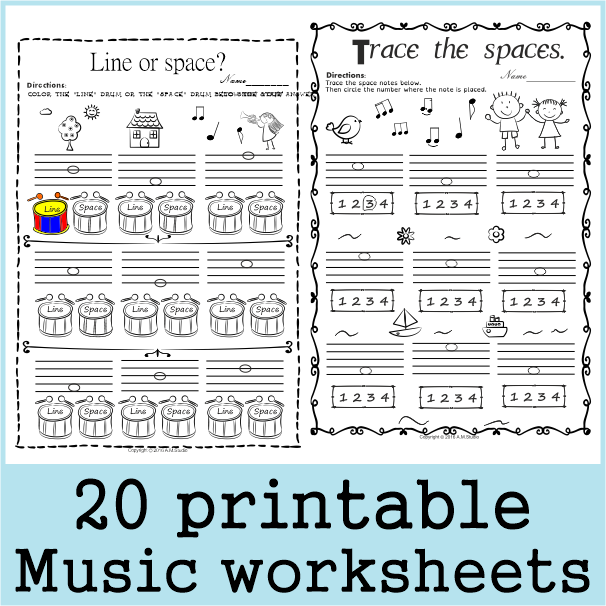
~ Line or space? Color the "Line" drum or the "Space" drum below the staff.
~ Line or space? Write “L” for the line notes and “S” for the space notes in the given boxes.
~ Line or space? Circle the line notes red and space notes green.
~ Color the instruments: with notes on the line red, with notes in the space orange, with notes off the staff yellow.
~ Trace the music notes on the staff.
~ Trace the lines. Trace the line notes below then circle the number where the note is placed.
~ Trace the spaces. Trace the space notes below then circle the number where the note is placed.
~ Draw the notes on the following lines.
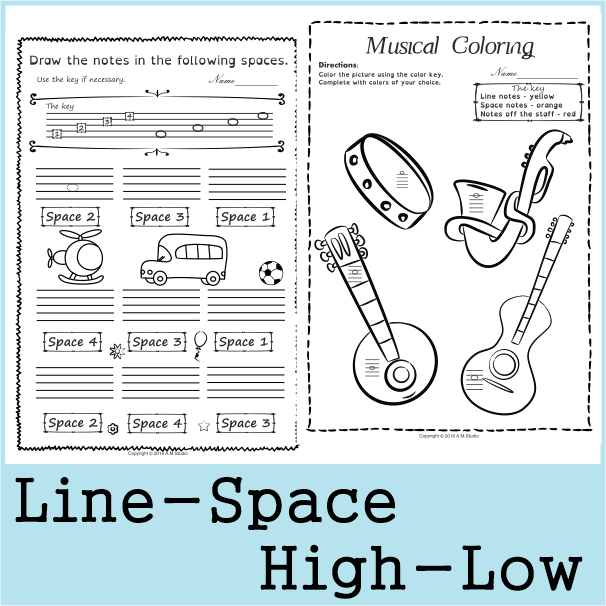
~ Draw the notes in the following spaces.
~ Which toy? Color the toy on the correct line or in the correct space.
~ Lines and Spaces. Write a note on the correct line or in the correct space.
~ Musical Coloring page 1. Line notes and Space notes (2 colors)
~ Musical Coloring page 2. Line notes, Space notes and notes off the staff (3 colors).
~ Musical Coloring page 3. Space notes (4 colors).
~ Musical Coloring page 4. Line notes (5 colors).
~ Musical Coloring page 5. Line and Space notes (9 colors).
High-Low (3 worksheets)
~ High or low? Color the higher “note” red and lower “note” yellow. Then use the letters H and L to indicate “notes” in the given boxes.
~ High or low? Circle the highest pitch on the staff. Draw an arrow to indicate whether the second note higher or lower in pitch than the first note.
~ I can! Draw a note on the indicated line or space. Then circle the highest note you drew on the staff.
Students will need a pencil, a ruler or straight edge, and crayons or colored pencils (red, green, yellow, orange, blue, brown, purple, pink, black).
| Activity / Page |
NCAS Code |
What Students Do |
Artistic Process |
| Line and Space Note Identification (pp. 3–6, 14–15) |
MU:Re7.2.1a |
Identify notes placed on staff lines versus spaces using color-by-element keys, circling, and letter labels. |
Responding |
| Reading Numbered Lines and Spaces (pp. 8–9, 12, 16–18) |
MU:Pr4.2.2b |
Read note and icon positions on numbered staff lines and spaces using standard and iconic notation. |
Responding |
| High and Low Pitch Contrasts (pp. 19–20) |
MU:Pr4.2.Ka |
Distinguish higher and lower pitches on staves using color coding, letter labels, and direction arrows. |
Responding |
Standards text © 2014 National Coalition for Core Arts Standards. Rights administered by SEADAE. Alignment interpretation by Anastasiya Multimedia Studio